
The experiment kit allows for a wide range of experiments on wave and quantum optics. These include:
- Michelson interferometer
- Mach-Zehnder interferometer
- Quantum eraser
- Experiments with slits and diffraction gratings
- Experiments on polarisation
- BB84 protocol
- Sagnac interferometer
Michelson interferometer
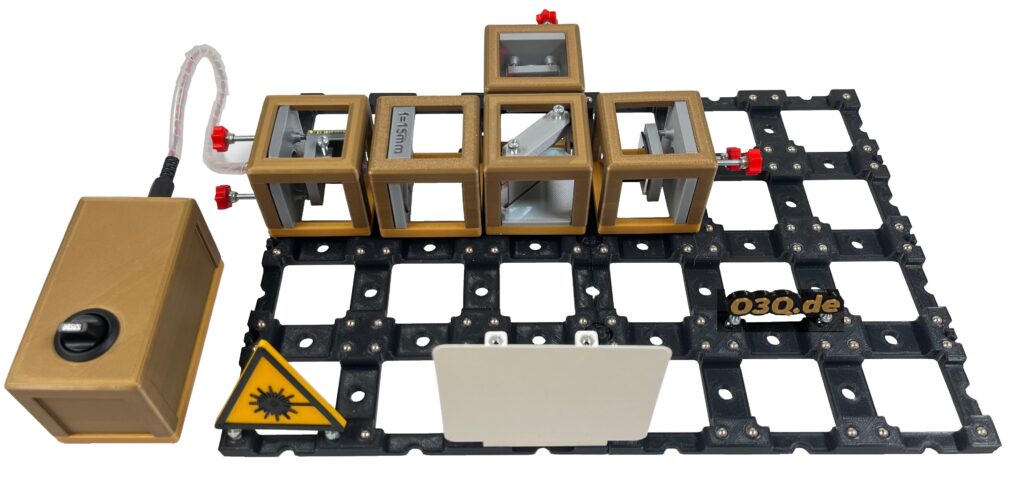
The Michelson interferometer can be assembled and adjusted quickly and easily. The modular design invites you to try it out and enables an intuitive approach to interference phenomena. By adding a piezo module, quantitative measurements can also be carried out, e.g. to demonstrate quantum mechanical superpositions or to investigate tiny changes in length on the wavelength scale. Further information can be found here.
Mach-Zehnder interferometer
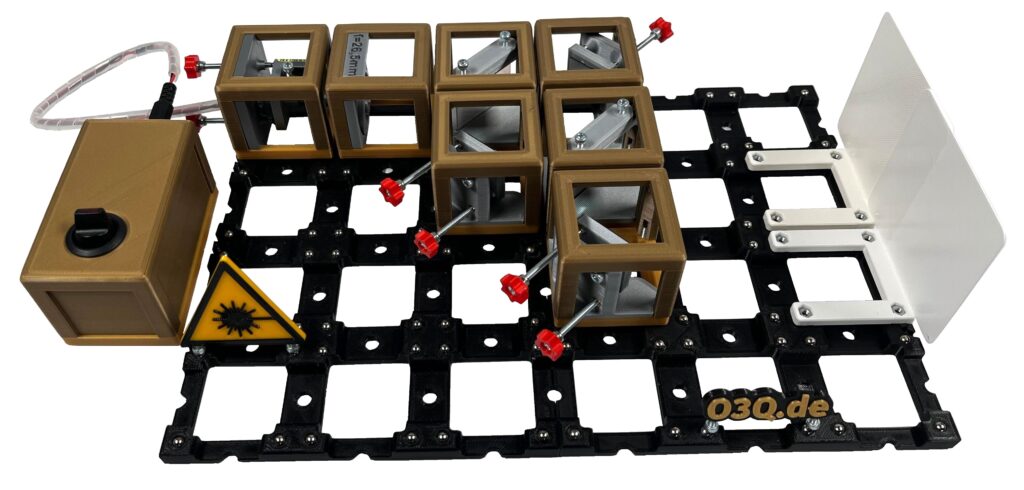
Some of the components from the Michelson interferometer can be reused for the Mach-Zehnder interferometer. The experiment offers a vivid opportunity to discuss interference and light splitting. Further information can be found here.
Quantum eraser
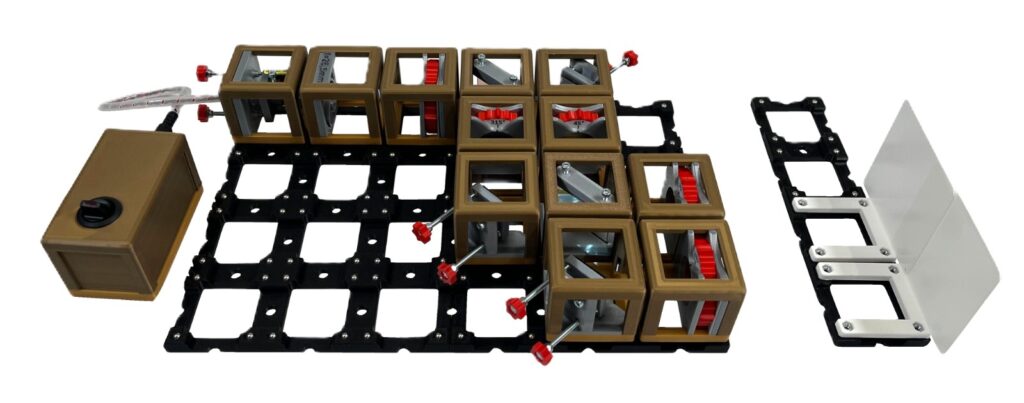
The analogy to the quantum eraser is an extension of the Mach-Zehnder interferometer. By adding polarization filters, the influence of polarization on the interference behaviour can be made visible. This provides a clear introduction to fundamental concepts of quantum mechanics. Further information can be found here.
Slits and diffraction grating
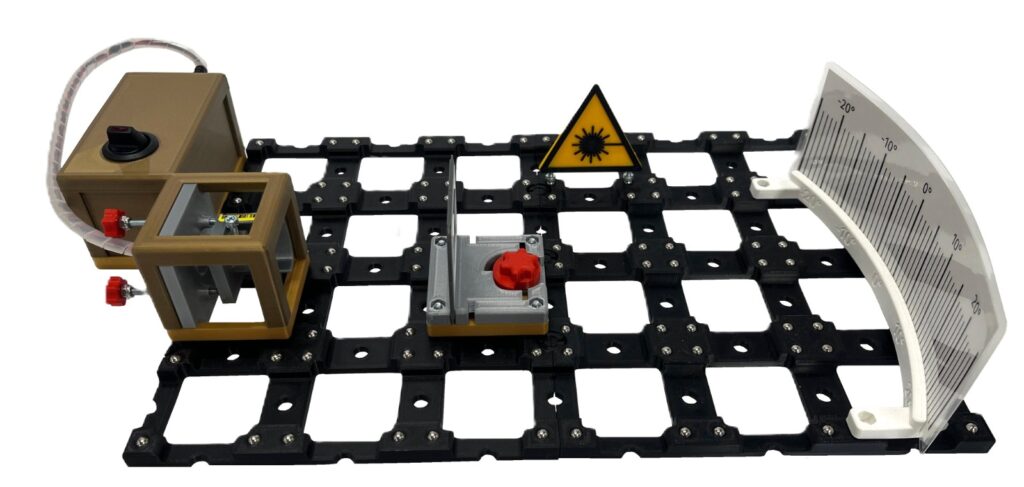
Various experiments can be set up to investigate diffraction and interference using gratings and slits. It allows the study of, e.g., single- and double-slit interference as well as diffraction at transmission gratings. The setup provides an intuitive and practical approach to wave optics and the fundamental properties of light. Further information can be found here.
Polarisation
With the modular kit, various experiments can be set up to investigate polarisation. It allows the study of, e.g., the polarisation of a laser diode, different light sources, the polarising properties of a beam splitter, the law of malus and rotation of polarisation with polarising filters (inverse quantum xenon effect). The setup provides a clear and hands-on approach to key concepts of polarization and its applications. Further information can be found here.
Polarisation of a laser diode
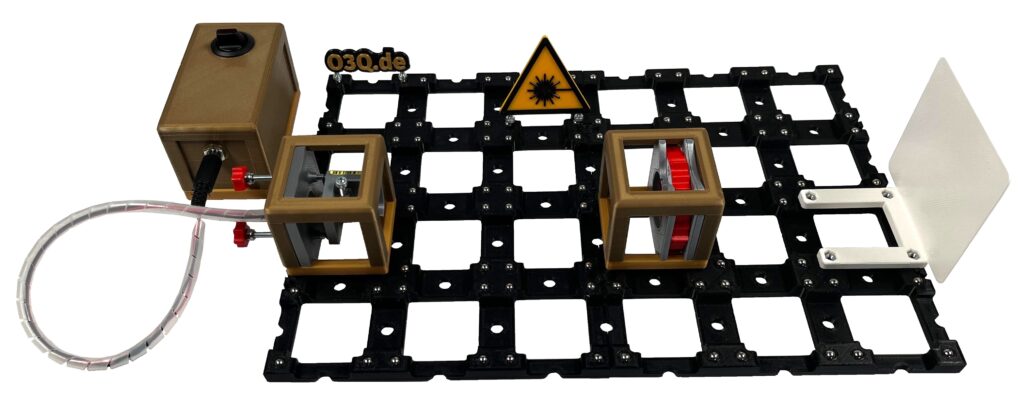
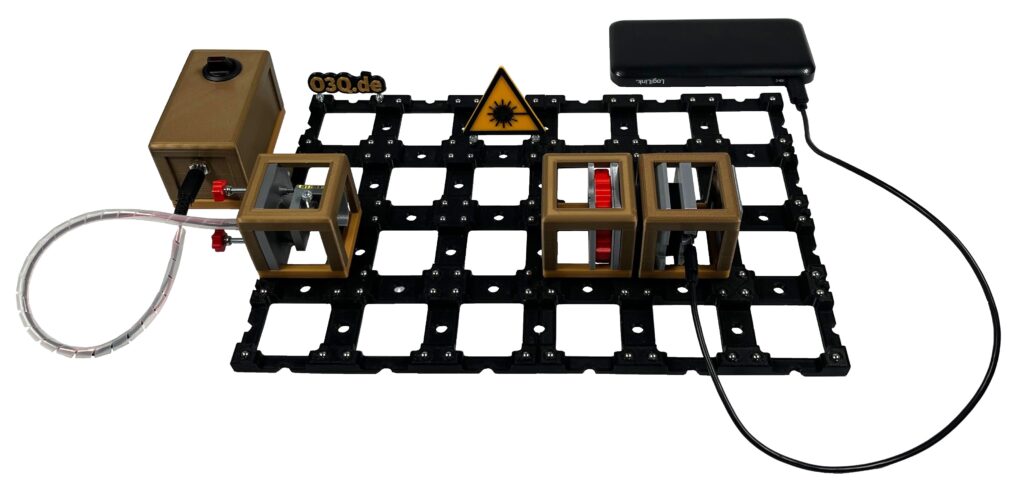
Polarisation of different light sources

Polarising properties of beam splitters

Law of Malus
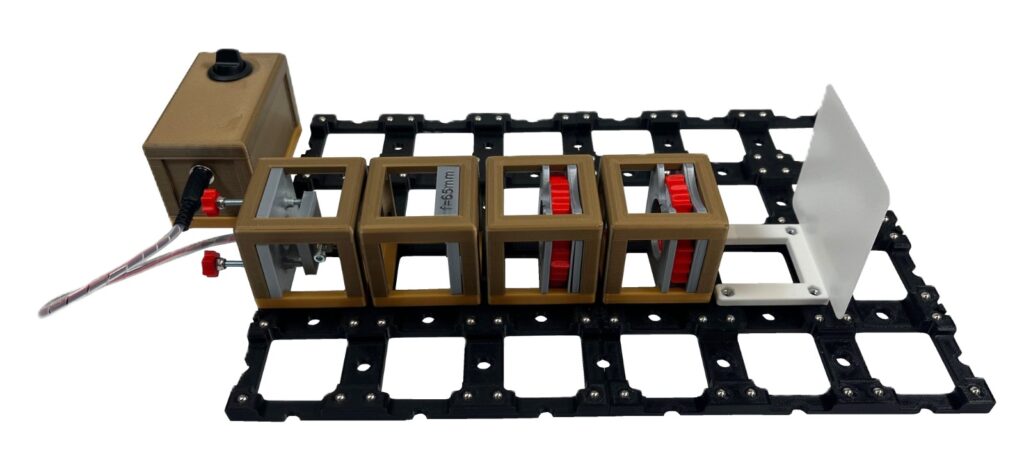
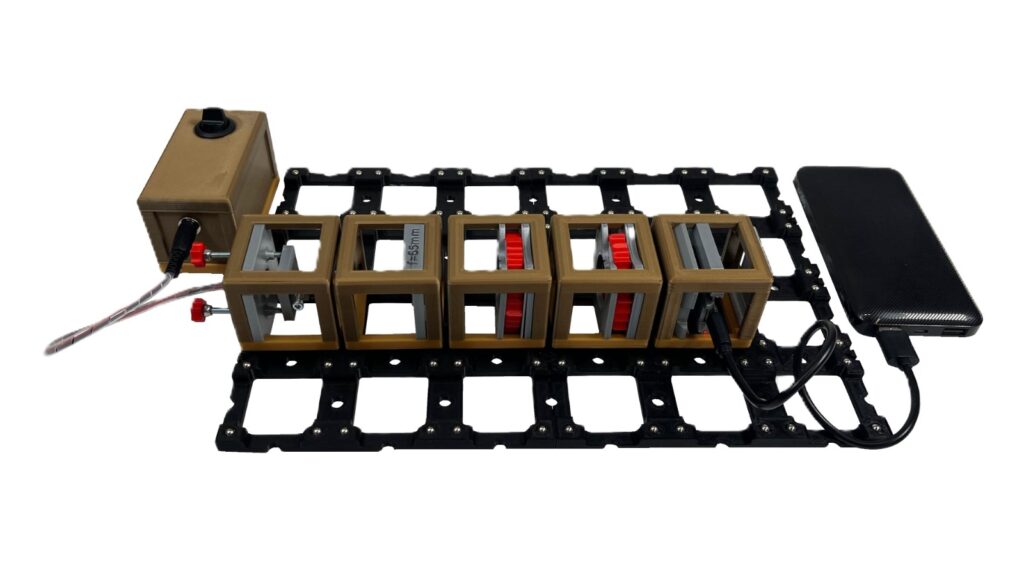
Rotation of polarsation with polarising filters (inverse quantum xenon effect)
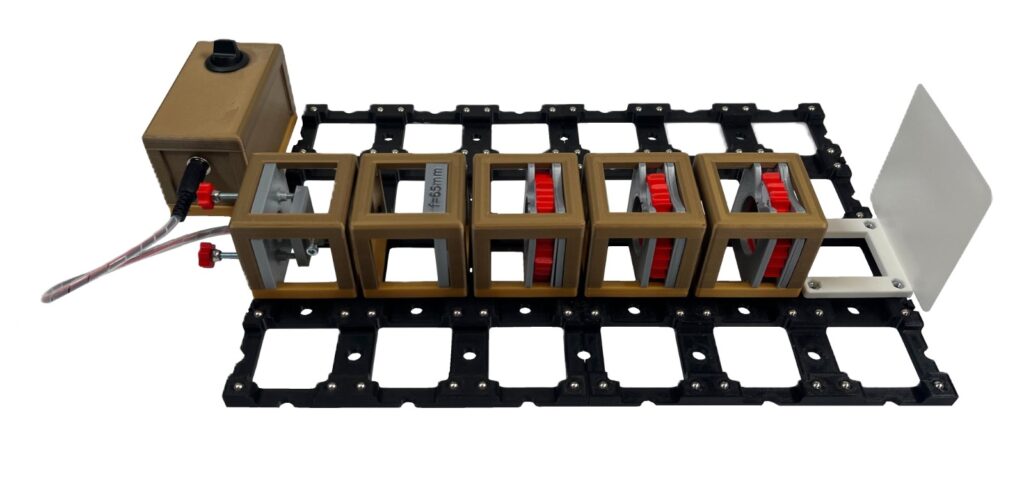
To perform quantitative observations or measurements, replace the screen with a light sensor.
BB84 protocol
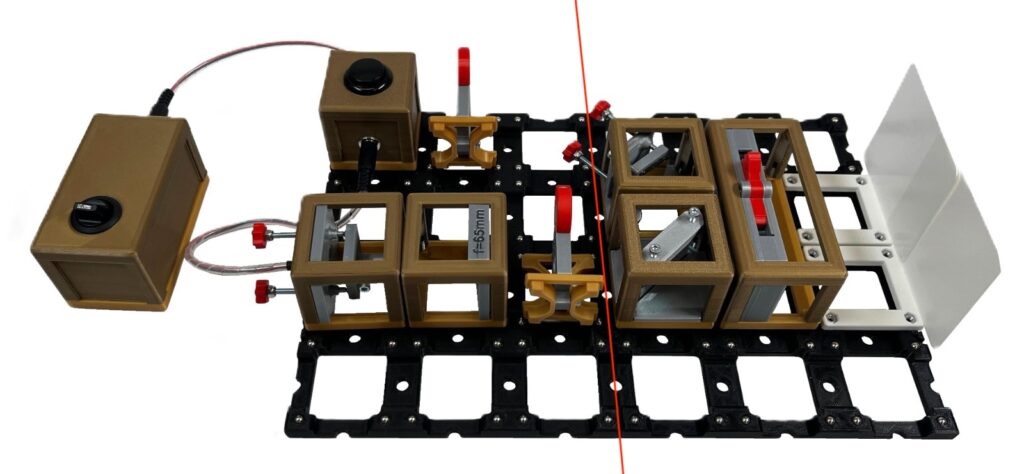
The BB84 protocol is used to generate secure keys for cryptographic encryption. Single photons are used to transmit individual bits. In this analogy experiment, the protocol can be reproduced with many photons and its functionality can be clearly demonstrated. Further information can be found here.
Sagnac interferometer

The Sagnac interferometer enables the observation of interference effects resulting from rotational motion. Its modular setup allows for quick assembly and straightforward alignment. By incorporating additional modules, the experiment can be extended to demonstrate the Sagnac effect, a key principle in modern gyroscopes and rotation sensors. Further information can be found here.